11 August 2024
Jakarta, 11 Agustus 2024 – PT Freeport Indonesia (PTFI), in conjunction with the Mimika Regency government, academicians, and Kamoro residents, is endeavoring to accelerate mangrove ecosystem restoration in the Ajkwa River estuary in Mimika, through the "Estuary Structure" program. This endeavor was comprehensively described during the LIKE 2 Festival talk show, which explored issues on the Environment, Climate, Forestry, and Renewable Energy, that was held by the Ministry of Environment and Forestry at the Jakarta Convention Center (JCC) in Jakarta on Saturday.
“The Estuary Structure program is by way of Freeport Indonesia fulfilling its commitment to environmental restoration. With involvement of the Kamoro people, the Mimika regency government, and academicians from Papua University, Diponegoro University, Bogor Institute of Agricultures, and Jakarta Institute of Science and Technology, we are endeavoring to restore the mangrove ecosystem in the Ajkwa River Estuary,” PT Freeport Indonesia General Superintendent for Reclamation & Projects, Environmental Division, Roberth Sarwom who was a speaker, said.
Roberth said PTFI is building Estuary Structures in the Ajkwa River estuary to trap sediment from mine tailings and transform the sediment into a terrain or solid ground to be planted with mangroves. PTFI is committed to conducting revegetation on the land formed over an area of 500 hectares per year. From 2005 to the present time, PTFI has revegetated 953.59 hectares of land, and this will continue to increase.
The Estuary Structure program engages 24 groups of Kamoro Tribe members who reside in the Mimika Regency lowlands. From the end of 2022 until 2023, PTFI had recruited 300 native members of the Kamoro Tribe to work on this endeavor.
Roberth said construction of the Estuary Structures applied the Geotab Structure and Bamboo Structure methods. The Geotab Structure entails introduction of tailings or sediment into large geomembrane containers. The sediment will settle and remain in the container, whereas residual tailings fluid will flow out through the container’s pores.
"The geotubes are then laid out along the coastline, to act as a to barrier that will retain sediment and form it into a stable terrain,” Roberth informed.
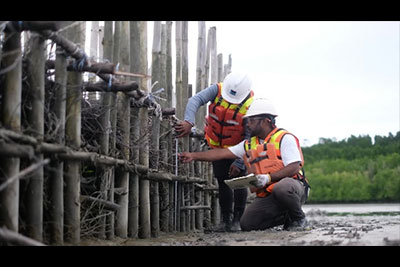
Meanwhile the Bamboo Structure method serves to trap and hold sediment by means of bamboo pole arrangement into forms resembling the letter “E” or “T”, thus their description as E-Groin or T-Groin structures. The bamboos are set in place about 200 cm into the ground and lined up into two rows of two tiers resembling a fence. The gaps between the tiers are filled with debris to retain the tailings sediment. This results in permanent deposition that will serve to create a stable terrain or solid ground.
"We expect this Estuary Structure Program to be fully utilized to benefit residents and to create a positive domino effect, with mangrove ecosystem restoration serving not only to restore environmental functions, but also to offer sustainable economic benefits for local residents,” Roberth said.
The Ministry of Environment and Forestry organized the LIKE 2 Festival held on 8 to 11 August as part of a sequence of events ahead of the COP 29 UNFCCC (29th Conference of the Parties of the United Nation Framework Convention on Climate Change) slated to take place from 11 to 22 November 2024 in Baja, Azerbaijan. PTFI actively participated in this festival, with an exhibition booth providing edification on Sustainable Mining that had hundreds of visitors on a daily basis.
| PHOTO | CAPTION |
|---|---|
|
|
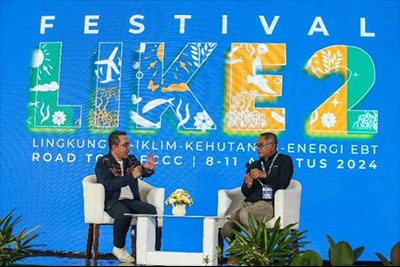
PT Freeport Indonesia General Superintendent Reclamation & Project, Environmental Division, Roberth Sarwom describing the Estuary Structure Project at the LIKE 2 Festival taking place in Jakarta Convention Center (JCC), on 10 August 2024. |
|
|
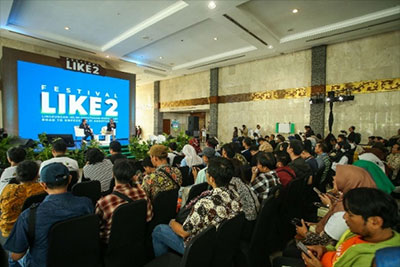
A talk show on Estuary Structures during the LIKE 2 event (on Environment, Climate, Forestry, and Renewable Energy) at Jakarta Convention Center (JCC), on 10 August 2024. |
|
|
PT Freeport Indonesia is building Estuary Structures at the Ajkwa River estuary in Mimika Regency to trap sediment from mine tailings and form the sediment into terrain or solid ground, to be planted with mangroves. |
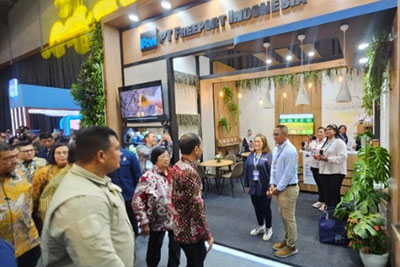 |
President Joko Widodo visiting the PT Freeport Indonesia boot during the opening of the LIKE 2 Festival, on Friday, 9 August 2024. |
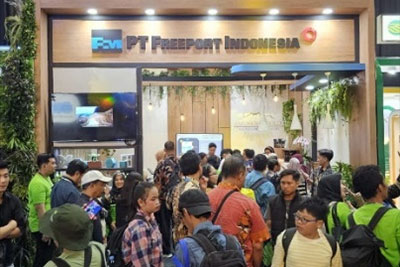 |
The PT Freeport Indonesia booth at the LIKE 2 Festival, saw a constant stream of visitors to attend the informative sessions on Sustainable Mining. |
About PT Freeport Indonesia (PTFI)
PT Freeport Indonesia (PTFI) is a mineral mining company affiliated with Freeport-McMoRan (FCX) and Mining Industry Indonesia (MIND ID). PTFI mines and processes ore to produce copper concentrate, which also contains gold and silver.
PTFI markets the concentrate to all parts of the world, and primarily to the first domestic smelter company, which is operated by PT Smelting. The PTFI mining operation is located in the Grasberg mineral district in Papua - Indonesia. PTFI currently runs the world’s biggest underground mining operation using the block caving method. In undertaking its mining operation, PTFI upholds and promotes responsible and sustainable business practices.
Contact Info
|
Katri Krisnati |
Desy Saputra |
Kami menghimbau para pencari kerja untuk berhati-hati dan mewaspadai beragam modus penipuan perekrutan yang mengatasnamakan PT Freeport Indonesia. Dalam setiap proses rekrutmen dan penerimaan karyawan, PT Freeport Indonesia maupun konsultan rekruitmennya tidak memungut biaya apapun.
Untuk melihat lowongan, silakan akses melalui link berikut: ptfi e-recruitment
Untuk melihat informasi magang, silakan akses melalui link berikut: Internship Program